Neighborhood Guide · Macland Road, McEachern & Toward Hiram
Macland & the McEachern Area (New Macland Road), Powder Springs: 10 Things to Know Before You Buy
Where this is: The southwest side of Powder Springs along Macland Road and New Macland Road, out toward the Paulding County line and the city of Hiram.
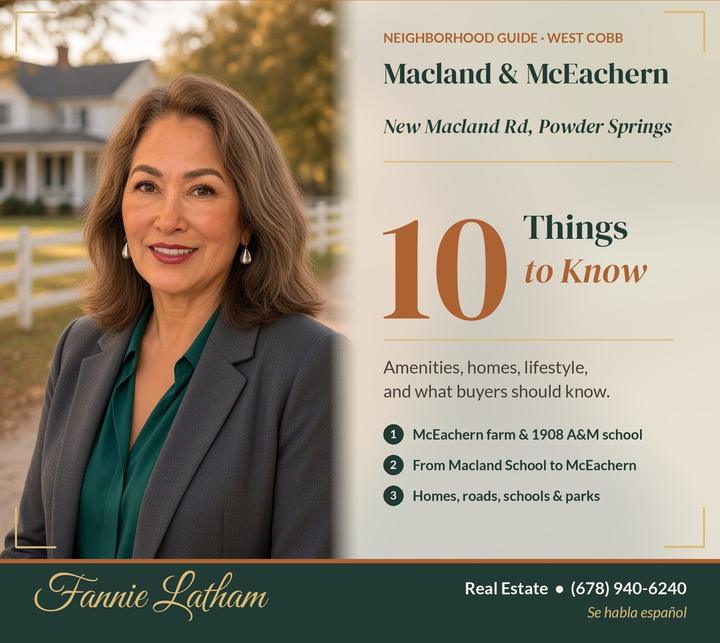
What should you know before buying a home in the Macland / McEachern area of Powder Springs?
Know that this is old farm country with a famous school at its heart. The community of Macland grew up along Macland Road (GA 360) and New Macland Road (GA 176), about 2½ miles north of downtown Powder Springs. It takes its name from the McEachern family, whose farm here was homesteaded in 1831, according to the Seven Springs Museum. In 1908, on 240 acres donated by John Newton McEachern Sr., the state opened the Seventh District Agricultural and Mechanical (A&M) School, a boarding high school for rural students. When the A&M schools closed in 1933, the campus became the Macland Consolidated School, and later John McEachern High School, which still stands on New Macland Road today. Know, too, that the area is a patchwork of city and county: some properties are inside Powder Springs city limits, and many are in unincorporated Cobb County, even though most share a Powder Springs 30127 mailing address.
This is the fifth stop in my series on the historic side of Powder Springs. After Historic Downtown, the Marietta and Atlanta Street homes, the old side streets and "the Flats," and the Lost Mountain crossroads, we head north on New Macland Road to Macland. For this guide, I read the Seven Springs Museum's histories of Gladston Farms and the Seventh District A&M School (including Margaret Virginia Tapp's 1962 thesis summary and students' reminiscences), McEachern High School's own history, the University of West Georgia's archive description of the A&M school's records, the history of McEachern Memorial United Methodist Church, the New Georgia Encyclopedia, Georgia DOT project records, Cobb County and City of Powder Springs pages, and current market data.
I'm Fannie Latham, a bilingual (English and Spanish) residential agent based in Marietta. I help buyers and sellers across Cobb, Paulding, Douglas, Cherokee, Pickens, Gwinnett and Clayton counties. Here are the ten things I'd want you to know.
1. Where Macland Is (and Whether You're in the City)
Think of Macland as the area where two roads meet north of downtown Powder Springs:
- New Macland Road (GA 176) runs north from Powder Springs past McEachern High School. North of Macland Road, the same state route continues as Lost Mountain Road toward the Lost Mountain crossroads (my last guide).
- Macland Road (GA 360) runs east–west, from Hiram in Paulding County toward Marietta, where it joins Powder Springs Road.
The museum's sources place the old A&M school "2½ miles north of Powder Springs and 9 miles from Marietta." McEachern High School's address today is , Powder Springs, GA 30127**.
City or county? It depends on the parcel. Powder Springs' city limits reach up parts of New Macland Road. A July 2024 city Planning & Zoning case, for example, involved properties on New Macland Road inside the city. But much of Macland, including stretches of Macland Road, is unincorporated Cobb County with a Powder Springs mailing address. Toward the east end of Macland Road, addresses can switch to Marietta 30064.
2. From "Camp Ground" to "Upshaw" to Macland
Before it was Macland, this community had two other names, according to the history of John Newton McEachern Memorial United Methodist Church:
- The 1830s: a log-cabin congregation. Pioneer families, including David Newton McEachern and his wife Esther Mary Ann White, who came from North Carolina in the 1830s, met for worship in a log cabin. In 1837 they organized Ebenezer Methodist Episcopal Church.
- "Camp Ground." Soon after, the people of Ebenezer and Powder Springs set up the Powder Springs Camp Ground, with a large camp-meeting shed in a grove of trees, where the church stands today. A log schoolhouse stood on the hill just south of the church.
- "Upshaw." A few years after the Civil War, I.D. Upshaw bought part of the church property and opened a store and post office, and the community became known as Upshaw.
- "Macland." Around the time the school was founded, the community took the name McLand or Macland. The museum says the name honors the McEacherns' extensive landholdings in the area.
What it means for you: When you drive Macland Road, you're driving through a community that has been gathering at this same spot for nearly 190 years.
3. The McEachern Family and Gladston Farms (Homesteaded 1831)
The Seven Springs Museum's "Historic Homes of Powder Springs" includes Gladston Farms (also called McEachern Farms), the home of John Newton McEachern Jr. Here's what the museum says:
- 1853: His father, John Newton McEachern Sr., was born on the farm. He went on to co-found the Industrial Life and Health Insurance Company (established 1891, later Life of Georgia).
- The 1940s: John N. McEachern Jr. restored the house and ran it as a working farm, with hogs, sheep and a stable of Tennessee Walking Horses.
- Today: The Mayes Ward-Dobbins Powder Springs (Macland) Chapel sits on the site. The museum says the owners had hoped to restore the old house as part of the funeral home but couldn't save it.
The family's generosity shows up all over Macland. The church history says that when Esther McEachern died in 1893, John N. McEachern Sr. bought and donated the land now known as Macland Cemetery (see #6).
4. The Seventh District A&M School (1908–1933)
This is the big story. In the early 1900s, rural Georgia had almost no accredited high schools, and farm families couldn't afford to send teenagers away to board in town. So in 1906, the Georgia General Assembly passed a law creating an agricultural and mechanical school in each congressional district. (The University of West Georgia's archive dates the act to August 18, 1906, and says it became known as the Perry Act.)
Here's how Macland won the Seventh District school, according to the museum (drawing on Margaret Virginia Tapp's 1962 thesis), the school and UWG:
- Opening day: The school opened on February 8, 1908, under principal Henry Robert Hunt, who had been superintendent of schools in Winder. The first building was a two-story, white-columned academic building. The museum says the bricks were made from clay Hunt found on the property.
- A working school: Students paid tuition and earned their board. Boys farmed, raised livestock and learned shop and machine skills. Girls studied cooking and home economics and cooked for the school. Students helped build the buildings and made bricks. A 1932 graduate remembered getting up at 3:30 a.m. to pump water and feed the animals, all for 10 cents an hour toward his tuition. The school even generated its own electricity.
- A famous graduate: Richard B. Russell Jr., later Georgia's governor and a U.S. senator for 38 years, graduated from the Seventh District A&M School in 1914, according to the New Georgia Encyclopedia.
- The end: With better roads and more local high schools, the state's district A&M schools lost their purpose. The state abolished them in 1933. The museum says efforts to turn this campus into a junior college failed, partly because the Fourth District school in Carrollton, about 40 miles away, had already become West Georgia's junior college (today's University of West Georgia).
5. From Macland Consolidated School to John McEachern High School
The Macland community insisted that its school buildings keep serving children. Here's the timeline, according to McEachern High School's own history and the University of West Georgia:
- October 1933: Five small Cobb County schools (Corner, Macland, Due West, Talley's and Mt. Zion) were combined into the Macland Consolidated School, which opened on the old A&M campus. The property formally transferred to Cobb County on June 19, 1935, according to the museum.
- 1960: McEachern fielded its first varsity football team, and its first stadium was built in 1965.
- 1975: The campus became one school, John McEachern High School, for grades 9–12.
History you can still see: Russell Hall, built in 1909 as the A&M boys' dormitory and rebuilt after a 1912 fire, was renovated in 1964 and named for Richard B. Russell. It houses the principal's office and a school museum. A brick Bell Tower stands where the first 1908 academic building stood, and the McEachern Nature Center (opened 1994) includes the restored pond from the A&M years. The campus is a working high school, so please visit only for public events, or call the school first.
A note on the museum's timeline: the Seven Springs Museum's education timeline says "1933 – The John McEachern High School was established." It's more accurate to say the consolidated school opened in 1933 on the A&M campus, took the McEachern name in 1938 and became "John McEachern High School" in 1975.
6. Macland Cemetery and McEachern Memorial United Methodist Church
- The church: The congregation that began as Ebenezer Methodist Episcopal Church in 1837 later dedicated a new chapel on June 5, 1932, as a memorial to John N. McEachern Sr., who died in 1928. A 1922 A&M graduate remembered boarding students lining up on Sundays to march to McEachern Methodist Church. The current sanctuary dates to 1990.
- The cemetery: Macland Cemetery, next to the church, sits on land John N. McEachern Sr. bought and donated after his mother's death in 1893. The church says the names on its stones "represent many of the pioneer families of our community."
Please be respectful: The church and cemetery are active community places, not tourist sites. Visit quietly.
7. The Homes: Older Farmhouses, Established Subdivisions and Newer Pockets
Today, Macland is suburban, with the old farm roads now lined with neighborhoods. GDOT's Macland Road project documents describe the corridor this way: "Recent developments of several residential neighborhoods and commercial establishments have changed the formerly rural landscape into a more suburbanized setting." You'll mostly find:
- Established single-family subdivisions from the last several decades, many with basements and wooded lots. (Macland Forest is on my list for its own future guide.)
- A few older homes on larger lots along the original roads.
What to check on a home here:
- HOA: It varies. Many subdivisions have mandatory associations, and some older homes on the main roads have none.
- Septic or sewer: Some older homes outside subdivisions may be on septic.
- Flood maps: Creeks run through this area (GDOT's map shows Powder Springs Creek, and Noses Creek crosses near Macland Road). Check FEMA flood maps for any lot near water.
- Age of systems: Look at the roof, HVAC, water heater and windows on older homes.
8. Macland Road Is Wider Now, and Growth Is Still Coming
What it means for you: Commutes on Macland Road should be easier than during construction, but this is a growing area. If you're buying on or near a main road, check the plans for nearby parcels with me before you commit.
9. Schools: McEachern Is the Anchor, but Always Confirm
Schools in and near Macland include:
- McEachern High School (the historic campus)
- Compton Elementary (opened 1969, per the museum's timeline)
- Tapp Middle School (opened 1975)
Depending on the street, some Macland-area homes may be zoned for other schools, including Hillgrove High School to the north. Always confirm your exact address with the Cobb County School District's school locator before you buy.
10. Parks, Shopping and Everyday Life
- Wild Horse Creek Park (Cobb County Parks): ball fields, lighted tennis courts, a BMX track, an equestrian center, a fishing pond, a playground and walking trails, plus Seven Springs Water Park and the Ron Anderson Recreation Center.
- Lost Mountain Park is a short drive north on Lost Mountain Road (see my Lost Mountain guide).
- Downtown Powder Springs, the Seven Springs Museum (free admission) and the Silver Comet Trail are a few minutes south on New Macland Road. The museum keeps copies of Miss Tapp's thesis and The History of the 7th District A&M School of Cobb County (Cobb County Georgia Genealogical Society, 1999), if you'd like to dig deeper.
Buyer tip: McEachern home football games and school events bring heavy traffic to New Macland Road. If you're looking at a home nearby, drive by on a Friday night in the fall.
Frequently Asked Questions About Macland and the McEachern Area
Is Macland a city? No. Macland is a historic community name. Parts of the area are inside Powder Springs city limits, and much of it is unincorporated Cobb County. Check the tax record for any home.
Where does the name "Macland" come from? From the McEachern family. The Seven Springs Museum says the community was named for the McEacherns' extensive landholdings. Before that, it was called "Camp Ground" and then "Upshaw."
When was McEachern High School founded? Its roots go back to the Seventh District A&M School, which opened on the same campus on February 8, 1908. The campus became the Macland Consolidated School in October 1933, the John McEachern Schools in 1938 and John McEachern High School in 1975.
Is the old McEachern farmhouse still standing? No. The museum says the Gladston Farms house couldn't be saved. A funeral home chapel sits on the site
How much do homes cost? Redfin's median sale price for Powder Springs 30127 was about $375,000 for the three months ending September 2026. Ask me for fresh comps near New Macland Road.
Is there an HOA? Many subdivisions have one. Some older homes on the main roads don't. Verify for each property.
Ready to Find Your Place in Macland?
Macland is for buyers who want an established Powder Springs neighborhood with real roots: a camp-meeting ground from the 1830s, a farm family that gave away hundreds of acres so rural kids could go to high school, and a campus where students once made the bricks, milked the cows and earned 10 cents an hour toward their tuition.
I'd love to be your guide. I'll check the tax district, school zoning, HOA rules, flood maps and nearby development plans for any home you like. I'll line up lenders, insurers and inspectors, and walk you through every step in English or Spanish. That's the Latham touch: local history, honest advice and a lot of heart. Call me at (678) 940-6240 or text me to schedule a showing or a relaxed, no-pressure conversation.
Resumen en español
Macland es una comunidad histórica al norte del centro de Powder Springs, a lo largo de Macland Road (GA 360) y New Macland Road (GA 176). Su nombre viene de la familia McEachern, cuya granja de 1,000 acres, Gladston Farms, fue fundada en 1831, según el Seven Springs Museum. Antes se llamaba "Camp Ground" y luego "Upshaw." En 1908, en 240 acres donados por John Newton McEachern Sr., abrió la Seventh District A&M School, un internado donde los estudiantes del campo trabajaban en la granja para pagar sus estudios. Cuando el estado cerró estas escuelas en 1933, el campus se convirtió en la Macland Consolidated School, luego en las John McEachern Schools (1938) y, desde 1975, en John McEachern High School, que sigue en el 2400 de New Macland Road. Algunas propiedades están dentro de los límites de la ciudad de Powder Springs y muchas están en el condado de Cobb no incorporado, aunque casi todas tienen dirección postal de Powder Springs 30127. La mediana de venta en el código 30127 fue de unos $375,000 (Redfin, septiembre de 2026). Macland Road ya tiene cuatro carriles y aceras nuevas. Siempre confirme la escuela, la cuota de HOA y el distrito de impuestos de cada casa. Con mucho gusto le ayudo a encontrar su casa.
Sources
- Seven Springs Museum (sevenspringsmuseum.org): "Historic Homes of Powder Springs, GA" (Gladston Farms entry); "The Seventh District A&M School, Macland Road, Powder Springs, Georgia" (July 20, 2024, by Margaret Virginia Tapp, from her 1962 Peabody College thesis); "Reminiscences of 7th District A & M School 1907–1933" (Nov. 23, 2024, from The History of the 7th District A&M School of Cobb County, ed. Mimi Jo Butler, Cobb County Georgia Genealogical Society, 1999); "Education Was Not Neglected in Powder Springs, GA" (Sept. 16, 2026); "Powder Springs Firsts, Part II, 1891 to 1935"
- McEachern High School: "The History of John McEachern High School" (mceachernhigh.org); Cobb County School District, McEachern High School Profile 2025–2026
- University of West Georgia Special Collections: Seventh District Agricultural and Mechanical School records (collection description)
- John Newton McEachern Memorial United Methodist Church: "About McEachern UMC" (mceachernumc.org)
- New Georgia Encyclopedia: "Richard B. Russell Jr." (Sheryl B. Vogt)
- Georgia DOT: GeoPI project page for PI 0006049 (SR 360 from New Macland Road to SR 120) and the Feb. 13, 2020, public information open house handout; Wikipedia, "Georgia State Route 360"
- Georgia Department of Community Affairs: public notice of annexation arbitration hearing (Nov. 2, 2026); NickO Report (Sept. 14, 2026)
- City of Powder Springs Planning & Zoning Commission minutes, July 29, 2024 (New Macland Road variance); Cobb County Parks (Wild Horse Creek Park); Cobb County School District school pages (Compton, Varner, Tapp); Kroger (Varner Crossing); Publix (Publix at Powder Springs); Mayes Ward-Dobbins (Powder Springs Chapel)
- Redfin: 30127 and 30064 housing market pages (data through September 2026)
- Historical Marker Database (hmdb.org): searched; no marker found for Macland, Gladston Farms or the Seventh District A&M School
More guides nearby
Macland Forest
Macland Forest is a 1990s swim-and-tennis neighborhood in Cobb County, on the west side of metro Atlanta, between Marietta and Powder Springs.
Read the guide →
Linden Grove
It is a brand-new single-family community in West Cobb, tucked between Macland Road and Gaydon Road, with a Powder Springs 30127 mailing address in Cobb County.
Read the guide →
Adams Landing
It's a mid-2000s single-family subdivision in West Cobb with roomy footprints, a modest HOA, and a location near the Macland–McEachern corridor, parks and everyday errands — without a confirmed community pool, tennis courts or clubhouse in the public sources I checked.
Read the guide →