Neighborhood Guide · Historic Downtown & In-Town Powder Springs
Historic Downtown Powder Springs, GA: 9 Things to Know Before You Buy
Where this is: Inside or right next to the City of Powder Springs, a small historic city in southwest Cobb County, about 21 miles northwest of downtown Atlanta.
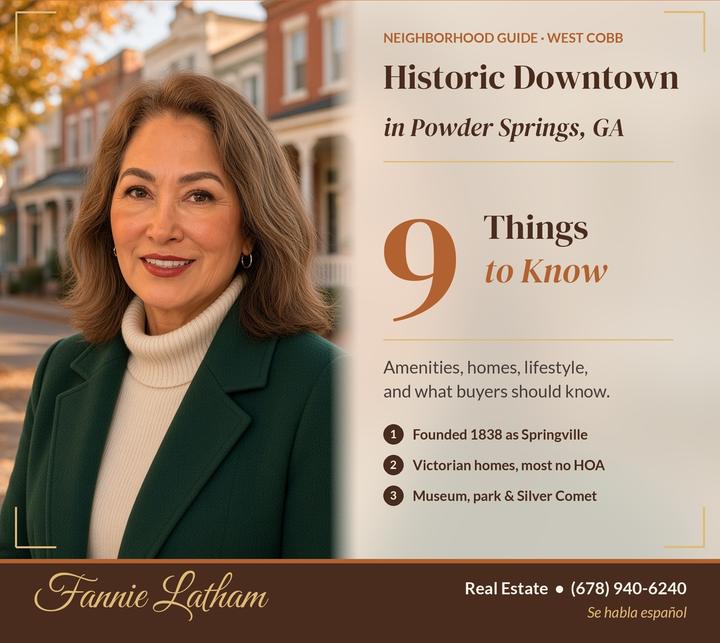
What should you know before buying a home in historic downtown Powder Springs?
That you'd be buying into one of the oldest town centers in Cobb County, a place that was a mineral-spring resort and a cotton and railroad town long before it was a suburb. You also need to know how the city's Historic Urban Core rules, city property taxes and a fast-changing downtown could affect the home you choose.
Long before there were subdivisions in West Cobb, there were seven mineral springs here. The Seven Springs Museum says the Cherokee and Creek knew the site as "Gunpowder Springs," because the mineral-rich water left a blackish, sulfur-smelling sediment in the sand that was "as dry as powder" once the water ran off. They brought their sick to the springs for the water's healing reputation. Settlers began arriving around 1819. The City of Powder Springs says the town was incorporated as Springville in 1838 on land associated with two Cherokee leaders, Chief Nose and Chief Ana Kanasta. Gold had been found in Georgia a decade earlier, and early settlers searched for it near Lost Mountain and off Brownsville Road. They found little gold. On December 19, 1859, Springville became Powder Springs.
Since then the town has been a health resort with a pavilion by the springs, a cotton-gin and farming center, a two-railroad town and, today, the fastest-growing city in Cobb County, according to the city's economic development director (Cobb In Focus, September 2026). Downtown, all of that history sits within a few walkable blocks: Victorian and early-1900s homes along Marietta Street and Atlanta Street, a wood-frame general store on the National Register of Historic Places, a volunteer-run history museum, and a new park and amphitheater beside the Silver Comet Trail.
1. The Seven Springs: Where Powder Springs Began
Downtown Powder Springs grew up around its springs. The town's first pioneers used them as their water supply, and the city kept using them as its water source after the 1859 renaming. The Seven Springs Museum notes that the water carries minerals that darkened the surrounding sand, and other accounts put the count at about 26 minerals.
Around 1840, a pavilion was built in the park near the springs. The museum's history pages describe it as the center of social life during Powder Springs' resort era. People came to drink the mineral water, and the pavilion hosted picnics, dances, political rallies, family and school reunions, with baseball games played just beside it. In 1882, railroads were advertising summer excursion trains from Atlanta to "the resort town of Powder Springs."
Some of the springs still sit in quiet corners of the historic district. The museum notes that one of the original springs is behind the historic Tapp House on Marietta Street, and that a cotton buyer named C.T. Leake kept his milk cold in one of the springs near Marietta Street and Brownsville Road.
Buyer tip: This is a town where neighbors know the stories. Ask the sellers and the museum volunteers about your house's history. You may be buying a piece of it.
2. The Homes: Victorian Porches, Folk Houses and the Streets Around Them
The Seven Springs Museum says most of Powder Springs' historic homes are on Marietta Street (the old main street, also US-278), with more one block over on Atlanta Street. Several date to the early or mid-1800s. Some of the landmark homes, as described by the museum:
- The Bodiford House (now the Seven Springs Museum): one of the town's most elaborate Victorian Queen Anne homes, with two cross gables, a corner tower and a decorative wraparound porch. It grew from a 19th-century two-story, four-room house with hand-hewn beams.
- The Camp-Boyd House: a smaller Victorian given as a wedding present around 1905–1910, with spindlework in the gable and lace-like porch supports.
- The Camp-Lawler ("Magnolia") House: an early-1900s plantation-plain house that was rolled to its current spot in 1930 when the road was widened.
- The Florence House: a Queen Anne Victorian built around 1915 with a second-story porch.
- The Leake-Lovinggood House: a two-story gable-front-and-wing folk house built in 1913 by C.T. Leake, a local cotton buyer. It was in the Lovinggood family for decades.
- The Tapp House: built before 1877 and in the Tapp family from 1918 until about 2019.
- The Murray House on Atlanta Street: built as a duplex for the daughters of Dr. Robert Root Murray, who came to practice medicine about 1860. His daughter Roberta Murray is remembered as the town's first historian.
Downtown's housing isn't only Victorian. Side streets like Old Lost Mountain Road, Dillard Street, Pineview Drive and Old Austell Road are some of the oldest sections of town. The museum points out that the stretch of Old Lost Mountain Road between Marietta Street and the Parkway is "an old section of town." Mixed in with the historic homes you'll also find mid-century and later houses, and newer multifamily housing. Springside, across from Thurman Springs Park, brought 226 residential units to the heart of downtown.
Powder Springs also has deep African American history downtown. The city says the Seven Springs Museum is known for its exhibit "Powder Springs Has Some Deep Roots in It," which tells the story of the historic neighborhood called "the Flats." The museum's railroad history says that after the Southern Railroad depot was built at the end of Atlanta Street around 1882, a number of Black families moved into the area around it, and landowners platted lots there. The railroad also built "section housing" for its African American workers. The museum's education timeline notes that schools for Black students, Liberty Hill and New Hope Missionary, were established in 1891.
Buyer tip: Historic homes are rarely on the market at the same time, and many are owned by families who have held them for generations. If you love the area, tell me early so we're ready when one comes up.
3. The Historic Urban Core Has Design Rules
In May 2020, the Powder Springs City Council approved design guidelines for downtown's Historic Urban Core by a 4–1 vote (Atlanta Journal-Constitution). The core is defined within the boundaries of the city's Downtown Development Authority. The city code says its purpose is to "protect the historic nature and character of the area." It describes the area's traditional pattern of one- and two-story buildings, brick and horizontal wood siding, and homes with "large sweeping porches."
Within those boundaries, the code:
- Requires certain materials: brick, stone, horizontal wood or cement siding, glass, and architectural-shingle roofs (or flat roofs with a parapet).
- Sets a color palette: Sherwin-Williams' "Fundamentally Neutral" palette or gradations of it.
- Requires design review: the Community Development Director reviews and approves new construction, additions and rehabilitation.
The city's Unified Development Code also has separate Residential Infill Development Guidelines covering setbacks, height, roofs, porches, windows, fences and front-yard trees.
What it means for you: If you dream of adding a porch, new siding, an addition or a new home on an in-town lot, plan for design review and build it into your timeline and budget. Before you make an offer, we can confirm with the city whether the property is inside the Historic Urban Core boundary and which rules apply.
4. Prices: What to Expect
Redfin reported a median sale price of about $350,000 for the City of Powder Springs over the three months ending September 2026 (up 1.7% year over year). The typical home sold in about 62 days, and sold for about 98.9% of list price. Those figures cover the whole city, though, not just downtown.
5. No HOA for Most Historic Homes, but You Will Pay City Taxes
Most older in-town homes aren't part of a homeowners association, which means no HOA dues and no HOA board approving your paint color. Downtown does have the city's Historic Urban Core and infill rules instead (see section 3).
Because downtown is inside the city limits, you'll also pay City of Powder Springs property taxes. The city lists its millage rate at 9.5 mills, and it says it has no separate school tax: school taxes appear on your Cobb County bill. City tax bills are normally mailed by the end of September and are due 60 days later. Ask about city exemptions you may qualify for.
6. Thurman Springs Park, the Silver Comet Trail and Railroad Roots
The heart of downtown today is Thurman Springs Park, home of the Hardy Family Automotive Amphitheater. The city calls it "the heart of the city." It hosts movie nights, concerts, festivals, the Juneteenth Unity Celebration, the 4th of July Celebration and the Christmas Parade and Tree Lighting. The splash pad usually runs from late May into September (10 AM–8:30 PM). Cobb In Focus describes the park as a $4.1 million investment with direct access to the Silver Comet Trail.
The trail has its own history. The Seven Springs Museum says the Seaboard Railroad arrived in 1905, carrying mail, passengers, freight and cattle to and from Atlanta. Its depot stood on Dillard Street until it was torn down in 1945. That rail bed is now the Silver Comet Trail. The older Southern Railroad line (built in 1882) had a depot on Murray Avenue that was demolished in 1973. Locals remembered riding the train into Atlanta to the movies for 15 cents.
Buyer tip: If trail access matters to you, walk or bike from the house you like to the trail before you buy. Some streets are an easy stroll, and others mean crossing busy roads.
7. A Walkable Little Downtown: Museum, Dining and Events
Downtown is turning into a place to spend an evening. Cobb In Focus (September 2026) points to Vesuvio Pizzeria Napoletana, Skint Chestnut Brewing Company (described as West Cobb's first brewery), Sangster's Cafe, The Book Worm Bookstore and Powder Springs Bistro. The city's historic downtown page also lists the Ford Center campus, the Towne Square, the historic cemetery and the Southern Quilt Trail. The city also hosts the Powder Springs Seafood Festival.
Two historic stops every downtown buyer should know:
- The Seven Springs Museum at the Bodiford House. The city bought the house and renovated it, and volunteers from the Seven Springs Historical Society run the museum. Admission is free. The museum lists hours of Wednesday 10 AM–1 PM, Saturday noon–4 PM and Sunday 1–4 PM.
- The Butner-McTyre General Store at Marietta and Broad streets, listed on the National Register of Historic Places in 2006. Its nomination calls it a rare surviving late-19th-century wood-frame general store. Its oldest section dates to about 1879 and once housed a livery, a blacksmith shop and a cotton warehouse. The main store dates to about 1881–1883, and a painted Coca-Cola sign is on one side.
8. Schools
According to the Cobb County School District, Powder Springs Elementary feeds Cooper Middle and McEachern High. It's also a direct link to the town's past. The school says it's the fourth facility to serve the community, tracing back to Springville Academy (1840), which became Powder Springs High School in 1859. Today the school is an arts integration school.
McEachern has deep roots too. In 1908, the Seventh District Agricultural and Mechanical School opened on land donated by John Newton McEachern Sr., and John McEachern High School opened on that campus in 1933.
9. Commute, Growth and Change Ahead
Downtown Powder Springs is about 12 miles southwest of Marietta (per its National Register nomination) and about 20 miles west of downtown Atlanta (per the city's Downtown Development Authority). US-278 runs right through town, and Richard D. Sailors Parkway and the East-West Connector carry traffic toward Marietta and the Cumberland area.
What it means for you: More restaurants, events and walkability are coming, along with more construction, traffic and change near the historic core. Ask me to check what's planned or zoned near any home you're considering.
What to inspect on an older or historic home: Depending on the home's age, look closely at:
- Foundation: pier-and-beam or brick-pier foundations, and crawlspace moisture.
- Systems: wiring (knob-and-tube or older panels), plumbing (galvanized or cast iron) and the sewer line, plus the age of the HVAC.
- Older materials: possible lead paint (common in homes built before 1978), and old porches and wood siding (check for rot).
- Past renovations: whether additions were permitted.
- Insurance: get quotes early, since older homes can cost more to insure.
Frequently Asked Questions About Historic Downtown Powder Springs
How old is Powder Springs? It was incorporated as Springville on December 29, 1838, and renamed Powder Springs on December 19, 1859. Settlers arrived around 1819.
Why is it called Powder Springs? Because of its seven mineral springs. The minerals turned the surrounding sand black, like gunpowder. The Cherokee and Creek called the site "Gunpowder Springs."
Is downtown Powder Springs a National Register historic district? Not that we could find. Downtown is a locally designated Historic Urban Core with design guidelines. The Butner-McTyre General Store is individually listed on the National Register (2006).
Is there an HOA downtown? Most historic in-town homes don't have one, but some newer communities may. City property taxes (9.5 mills) and the Historic Urban Core design rules do apply. Verify for each property.
What schools serve downtown Powder Springs? The Cobb County School District lists Powder Springs Elementary feeding Cooper Middle and McEachern High. Always confirm your address with the district.
How much do homes cost? The city-wide median was about $350,000 (Redfin, three months ending September 2026). Downtown prices vary widely by home type and condition.
Ready to Own a Piece of Powder Springs History?
Historic downtown Powder Springs is a great fit if you want front porches and old trees instead of cookie-cutter floor plans, a museum and a general store with stories to tell, and the Silver Comet Trail and a park a short walk from your door. You also get a small-town downtown that's growing up fast.
I'd love to be your guide. I'll pull the newest sales, check the Historic Urban Core boundary, school zoning and any nearby development for any home you like, and walk you through every step in English or Spanish. That's the Latham touch: local history, honest advice and a lot of heart. Call me at (678) 940-6240 or text me to schedule a showing or a relaxed, no-pressure conversation.
Resumen en español
El centro histórico de Powder Springs es uno de los más antiguos del condado de Cobb. El pueblo nació alrededor de siete manantiales minerales, conocidos por los cheroquis y los creeks como "Gunpowder Springs". Se fundó como Springville en 1838 y cambió su nombre a Powder Springs en 1859. Hoy tiene casas victorianas y antiguas en Marietta Street y Atlanta Street, el Museo Seven Springs (entrada gratis), una tienda general del siglo XIX en el Registro Nacional de Lugares Históricos, y el parque Thurman Springs junto al Silver Comet Trail. La mayoría de las casas históricas no tienen HOA, pero sí pagan impuestos de la ciudad (9.5 mills) y deben seguir las normas de diseño del centro histórico. La mediana de venta en la ciudad fue de unos $350,000 (Redfin, septiembre 2026). Las escuelas son Powder Springs Elementary, Cooper Middle y McEachern High, pero siempre confirme con el distrito escolar de Cobb. ¿Le interesa vivir en el centro histórico? Con mucho gusto le ayudo.
Sources
- City of Powder Springs: Visitors/History; Historic Downtown Powder Springs; Thurman Springs Park; Seven Springs Museum at the Bodiford House; Property Tax (powderspringsga.gov)
- Seven Springs Museum (sevenspringsmuseum.org): The Seven Springs of Powder Springs; Powder Springs Firsts 1828–1890; Historic Homes and More Historic Homes of Powder Springs; The Railroads Come to Powder Springs; The Other Streets in Town, Part II; Education Was Not Neglected; Odd Bits of Information
- National Park Service: National Register nomination, Butner-McTyre General Store (NRIS 05001593, listed 2/1/2006)
- Powder Springs Unified Development Code, Division VI: Historic Urban Core (Sec. 5-101 to 5-107)
- Atlanta Journal-Constitution, "Powder Springs Council sets up historic district" (May 11, 2020)
- Cobb In Focus, "City Spotlight: Powder Springs" (Sept. 8, 2026)
- Marietta Daily Journal, "Powder Springs to hear proposal for 251 apartments, 24 townhomes" (Oct. 23, 2026)
- City of Powder Springs DDA 2025 RFP for redevelopment of DDA-owned properties
- Cobb County School District: Powder Springs Elementary "About School" and "Feeder Schools"
- Redfin, Powder Springs housing market (September 2026)
More guides nearby
Historic Marietta Street & Atlanta Street
These are the two oldest residential streets in town, and they have very different personalities.
Read the guide →
The Old Side Streets & “the Flats”
These streets were built by the railroad, the cotton gins, the churches and the families who worked in them.
Read the guide →
Brownsville Road Area
This is one of the town's oldest edges — a westbound corridor that starts at Marietta Street (GA 278) downtown and runs out toward Paulding County.
Read the guide →