Neighborhood Guide · Historic Downtown & In-Town Powder Springs
Historic Marietta Street & Atlanta Street, Powder Springs: 10 Things to Know Before You Buy
Where this is: Inside or right next to the City of Powder Springs, a small historic city in southwest Cobb County, about 21 miles northwest of downtown Atlanta.
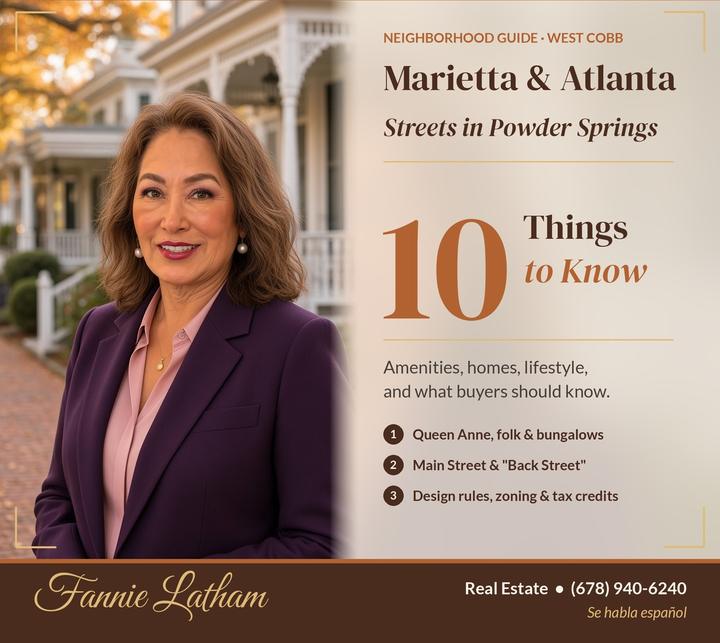
What should you know before buying a historic home on Marietta Street or Atlanta Street in Powder Springs?
Know that these are the two oldest residential streets in town, and they have very different personalities. Marietta Street was the town's grand main street, and today it's also a busy highway. Atlanta Street, which old-timers called "Back Street," is quieter and more modest. Know how to recognize what you're looking at: Queen Anne, folk Victorian, plantation plain and Craftsman bungalow are all here. And know that zoning, design rules, the age of the house and Georgia's historic-rehab incentives can matter as much as the paint color.
In my last guide, I covered Historic Downtown Powder Springs as a whole: the seven springs, Thurman Springs Park, the Silver Comet Trail, the shops and the town's growth. This guide slows down and goes street by street. I walked through the Seven Springs Museum's "Historic Homes of Powder Springs," "More Historic Homes of Powder Springs," "The Other Streets in Town," "Remembering Powder Springs High School" and "A Stately Street Turns the Corner" pages. I also read the City of Powder Springs' 2024 Design Guidelines and zoning code, the Georgia historic house-type definitions, and the state's historic tax incentive rules. The goal is to help you understand what makes these two streets special and what it really takes to buy and care for an old house on them.
I'm Fannie Latham, a bilingual (English and Spanish) residential agent based in Marietta. I help buyers and sellers across Cobb, Paulding, Douglas, Cherokee, Pickens, Gwinnett and Clayton counties. Here are the ten things I'd want you to know.
1. Two Streets, One Story: "Main Street" and "Back Street"
According to the Seven Springs Museum, most of Powder Springs' historic homes are on Marietta Street, the old main street, and others are "one street over (or back)" on Atlanta Street. Several date to the early or mid-1800s.
The museum explains that Atlanta Street "was often referred to as Back Street in the early days." It runs one block over and parallel to Marietta Street, from Old Austell Road, across the Lewis Road extension roundabout, to Murray Avenue. You can get from Marietta Street to Atlanta Street by way of Walton Street or Dillard Street.
The two streets grew up together. Doctors, merchants, a cotton buyer, a druggist and the town's first historian lived on them. Some of the families who worked in the bigger houses lived on the back street. The museum notes, for example, that the household help for the Camp-Boyd House on Marietta Street lived directly behind it on Atlanta Street. At the far end of Atlanta Street, near the railroad, were the depot, cotton gins, warehouses and mills that powered the town.
Buyer tip: Walk both streets, not just one. A house on Atlanta Street can be a short walk from everything on Marietta Street, with less traffic noise.
2. Marietta Street: The Old "Scenic Stretch" (and Today's US-278)
Marietta Street is Powder Springs' main street, and it is also Highway 278. The museum's history pages say the first paved road in Powder Springs was built in 1928, connecting the town to Austell along what is now Highway 278. Sidewalks were paved too, and the road was widened in 1930.
That widening left its mark on the street. The Camp-Lawler (Magnolia) House was rolled to its present spot in 1930 to make room for the road. And according to the museum, Emma Camp of the Camp-Boyd House was so determined to save the row of oaks in front of her house that she met the state road engineers with her shotgun. They left her trees alone, and she stood guard on her porch through the whole project.
Marietta Street is also, in a way, the center of town. The museum says the town's 1859 charter set the city limits as a half-mile radius from a spot that later owners of the Magnolia House placed in the middle of their entrance hall.
In November 1990, the Atlanta Journal-Constitution ran a story about Marietta Street headlined, in part, "Stately Homes' Era Passing." The museum's summary of that article says there were nine for-sale signs along about a half-mile stretch leading into the town square. The properties had been zoned for office and industrial uses. Owners talked about how hard the big old houses were to maintain. The museum adds that some of those stately homes have since been torn down.
What it means for you: Many of the grand houses on Marietta Street have already become businesses, event spaces or offices. The ones that remain homes are precious and rarely come up for sale. Expect highway traffic and commercial neighbors as part of the package.
3. A Walking Tour of Marietta Street's Landmark Homes
These are some of the landmark houses the Seven Springs Museum describes on Marietta Street, with their historic names:
- The Bodiford House (now the Seven Springs Museum). The museum calls it one of Powder Springs' most elaborate Queen Anne Victorian homes, with two cross gables, a corner tower and a decorative wraparound porch. Its core was a two-story, four-room house with hand-hewn beams dating to the 1800s. Merchant John L. Butner added the existing structure around 1910. Robert G. Bodiford bought it in 1954, and the City of Powder Springs purchased it from his estate in 2014. It's the one landmark you can walk inside: admission is free.
- The Camp-Lawler House ("Magnolia House"). The museum calls it an outstanding example of the plantation plain style. It was built in the early 1900s for Tom and Bright Camp on the site of the old Stovall Hotel, one of several hotels from the town's mineral-springs resort days. It was rolled to its present position in 1930. The museum says Tom Camp installed his own gas and light system in the house, and that one of the original seven springs runs behind the property. Today it's an event venue.
- The Florence House. A Queen Anne Victorian built around 1915 by W.D. Florence and Ida Butner Florence. It has an irregular hip-and-gable roof, a decorative masonry chimney, classical columns, cantilevered wall extensions and a second-story porch. The museum says it has been used as a funeral home since 1953.
- The Camp-Boyd House. A smaller Victorian given as a wedding present around 1905–1910 by Mrs. W.Y. Stovall to her son Charlie Camp and his wife Emma. Look for the spindlework in the gable, the lace-like porch supports and balustrade, and the corner tower on the porch.
- The Tapp House. Built before 1877 by Dr. W.T. Lackey, and in the Tapp family from 1918 until about 2019. It was the childhood home of Virginia Tapp (1911–1992), a teacher who helped record the town's history. Her brother W.R. "Bill" Tapp Jr., an architect, designed First Baptist Church of Powder Springs' 1964 building. The museum says one of the original seven springs is behind the house.
- The Leake-Lovinggood House. A two-story gable-front-and-wing folk house built in 1913 by C.T. Leake, a local cotton buyer. It stands on the site of an earlier house so steep-roofed it was said to "split a raindrop," which children thought was haunted. The Lovinggood family, who ran a grocery store in town for almost 50 years, have owned it since 1927. Mr. Leake kept his milk cold in one of the seven springs near the corner of Marietta Street and Brownsville Road.
Marietta Street isn't only houses. The museum notes that the Primitive Baptist Church stands where Old Lost Mountain Road, Marietta Street and Jackson Way meet. Its congregation formed after a split in the town's Baptist church around 1840.
Buyer tip: Visit the museum before you house-hunt. Its volunteers, its research room and its local history books (including Images of America: Powder Springs and the Seven Springs Sampler) can tell you more about the history of a street or a house than any listing.
4. Atlanta Street: Modest Homes, Big Stories
The museum says the homes on Atlanta Street "are more modest than those on Marietta Street," but they "offer architectural variety." Most were built in the early 1900s. It describes three Craftsman bungalow-style houses from the 1920s, a one-story front-and-wing folk house, and a house with an enclosed porch across the front. In the 1990s, a turn-of-the-century corn crib was still standing behind one of them.
Atlanta Street's history is full of the people who made the town work:
- The Murray House, built as a duplex for the daughters of Dr. Robert Root Murray, who came to practice medicine about 1860. His daughter Roberta Murray is known as the town's first historian. She opened her personal library to the town's young people long before Powder Springs had a library. She lived there until 1974.
- The Spratlin House, built in the early 1900s by King William and Beulah Spratlin. Mr. Spratlin had a grocery store downtown. The museum has an undated ad from his store offering 15 pounds of sugar for $1.
- The Hilley/Griffith house. Restaurant owner Benjamin L. Hilley's house was the only one on the block with telephone service in the 1930s. Later, Dr. J.A. Griffith lived there. In the late 1940s he built the Powder Springs Hospital next door and served as its doctor until it closed in the 1960s.
- The Penn House, built in the early 1900s by Luke Penn on the site of his grandfather's home. His grandfather, Rev. Alec Penn, was a prominent religious leader in Cobb and Douglas counties. Luke Penn was the custodian at Powder Springs School for about 40 years.
Atlanta Street was also the town's school street. In the 1870s, the Powder Springs Academy moved to a site on Atlanta Street with one of the seven springs behind it. The museum says boys considered it an honor to be chosen to fetch the students' water from the spring. In 1920, a brick Powder Springs High School was built on Atlanta Street. It taught grades one through eleven until South Cobb High opened in 1952, then became an elementary school. It closed in 1988 and was torn down in 2006. Today the Cobb County Powder Springs Library stands on that campus. It opened there in January 2008. Its meeting room was designed to evoke the old school and is named for Luke Penn.
The museum also notes that the site of Kite's Chapel was at the corner of Butner and Atlanta streets, and that an eatery and a Masonic lodge for Black members once stood at Atlanta and Anderson streets. Toward the railroad end of the street were the Southern Railroad depot (at Atlanta Street and Murray Avenue), cotton gins, a sawmill and a grist mill. The historic African American neighborhood known as "the Flats" grew up nearby. That deserves its own careful telling, and it's the subject of a future guide.
Buyer tip: Atlanta Street is where you're more likely to find a smaller historic home, like a bungalow or a folk cottage, at a more approachable size.
5. How to Read the Architecture
Powder Springs' 2024 Design Guidelines define their residential styles using Georgia's Living Places from the Georgia Department of Natural Resources and Virginia Savage McAlester's A Field Guide to American Houses. Here's a quick field guide to what you'll see on these two streets:
- Queen Anne Victorian (Bodiford House, Florence House): asymmetrical, with towers, cross gables, bay windows, varied wall textures and big wraparound porches. The city's guidelines note that the style dominated between the 1880s and 1900 and faded in the early 1900s. Powder Springs' Queen Annes, from about 1910–1915, are later examples.
- Folk Victorian and gable-front-and-wing (Leake-Lovinggood House): simpler shapes, often an L or T plan, with Victorian trim like spindlework or "gingerbread" brackets on the porch. The New Georgia Encyclopedia defines a gabled-wing (gabled-ell) house as L- or T-shaped, with intersecting gable roofs.
- Plantation plain (Camp-Lawler/Magnolia House): a two-story house one room deep, with a one-story shed across the back and usually a full-width front porch. The Encyclopedia describes it as a rural house type, which makes an in-town example especially interesting.
- Craftsman bungalow (on Atlanta Street): low-pitched gable roofs, wide eaves with exposed rafters, and porches with tapered square columns on piers. The city's guidelines say most smaller houses built from 1905 to 1920 were Craftsman, and very few were built after 1930.
Why it matters: Knowing a house's style helps you tell what's original and what's been changed. It also guides you toward the right windows, porch railings, trim and paint when you renovate.
6. Know the Rules: Historic Urban Core, Design Guidelines and Zoning
Three sets of rules can apply on these streets:
- The Historic Urban Core. In May 2020, the City Council approved downtown design rules by a 4–1 vote (AJC). They apply within the Downtown Development Authority boundaries. They require certain materials (brick, stone, horizontal wood or cement siding, glass, architectural-shingle roofs) and colors from Sherwin-Williams' "Fundamentally Neutral" palette or similar shades. The Community Development Director reviews new construction, additions and rehabilitation.
- The 2024 Design Guidelines (adopted October 7, 2024). The city can require them for new construction and rehab projects. For houses, the guidelines say that when renovating a historic house, original windows should be retained when possible. They suggest colors from Sherwin-Williams' "Fundamentally Neutral" and "Victorian Collection," and they don't allow vinyl or aluminum siding, painted brick or stucco without the Community Development Director's permission. New porches should be at least 6 feet deep. The guidelines also say that owners of historic houses may use them to guide exterior projects that don't need a permit. The city's website also still posts the Downtown Development Authority's older Historic Property Design Guidelines from 2002.
- Zoning. The houses along these streets don't all have the same zoning. Under the city's zoning code, the CBD (Central Business District) allows existing single-family homes. It treats new detached single-family homes as a special use and considers townhomes and lofts especially appropriate. Other in-town lots may be office/institutional or residential. A Downtown Redevelopment Overlay also covers the city's Livable Centers Initiative study area.
What it means for you: Before you make an offer, we should confirm the zoning and whether the house is inside the Historic Urban Core. Zoning can affect what you can build, whether you can rebuild after a loss, your financing, your appraisal and your insurance. If you're dreaming of a porch, an addition, new siding or paint, plan for design review in your timeline and budget.
7. Prices, Rarity and How These Homes Come to Market
Redfin reported a median sale price of about $350,000 for the City of Powder Springs over the three months ending September 2026 (up 1.7% year over year), with homes selling in about 62 days for about 98.9% of list price. That's a city-wide number, though, and it tells you little about a 100-year-old house on Marietta Street.
How I'd approach it:
- Get pre-approved with a lender who understands older homes. Appraisers and underwriters may look closely at condition, zoning and comps.
- Get insurance quotes early. Older roofs, wiring and plumbing can affect your premium, or whether a home can be insured at all.
- Hire an inspector who knows old houses, and consider specialists for the foundation, the sewer line (a camera scope), wood-destroying insects and the chimney.
- On an older or historic home, look closely at: pier-and-beam or brick-pier foundations and crawlspace moisture; old wiring (knob-and-tube or outdated panels); galvanized or cast-iron plumbing; possible lead paint (common in homes built before 1978); wood rot in porches, siding and windows; and whether past additions were permitted.
8. No HOA, City Taxes, and Georgia's Historic Rehab Incentives
Most historic homes on Marietta Street and Atlanta Street aren't in a homeowners association. Because these streets are inside the city limits, you'll pay City of Powder Springs property taxes. The city lists its millage rate as 9.5 mills, and school taxes are on your Cobb County bill.
If you're planning a real rehab, Georgia has two state incentives worth knowing about:
- State income tax credit: 25% of qualified rehabilitation expenses, capped at $100,000 for a principal residence (Georgia Department of Community Affairs). The house must be listed in, or eligible for, the National or Georgia Register of Historic Places. Starting with projects that began on or after January 1, 2026, an owner-occupied home that is locally designated, or that contributes to a local historic district, can also qualify. The project has to meet the state's rehabilitation standards and a "substantial rehabilitation" threshold, and you must apply before the work starts.
- Preferential property tax assessment: a freeze of the county property tax assessment for about 8.5 years if the property is listed in, or eligible for, the National or Georgia Register, the work meets state standards, and the rehab raises the home's value enough (50% for a principal residence).
There's no National Register historic district on these streets that I could find, and the Butner-McTyre General Store is the only nearby building I confirmed is individually listed.
9. Everyday Life: Walkable History, with a Highway Out Front
Living on these streets puts you within walking distance of the Seven Springs Museum, the Powder Springs Library and the Ford Center campus on Atlanta Street, Thurman Springs Park and its amphitheater, downtown restaurants and the Silver Comet Trail (built on the old Seaboard Railroad bed). The city hosts events throughout the year, from the Juneteenth Unity Celebration and the 4th of July to the Christmas Parade and Tree Lighting. (My Historic Downtown guide has the full rundown.)
The trade-offs are just as real. Marietta Street is US-278, a working highway with traffic, trucks and noise. Many of your neighbors may be offices, churches, a funeral home or an event venue, and downtown is changing quickly with new apartments and redevelopment proposals. Atlanta Street is quieter, but it's still in the middle of a growing downtown.
Commute: Powder Springs is about 12 miles southwest of Marietta (National Register nomination for the Butner-McTyre General Store) and about 20 miles west of downtown Atlanta (Downtown Development Authority). Richard D. Sailors Parkway and the East-West Connector carry traffic toward Marietta and the Cumberland area.
Buyer tip: Visit at rush hour, on a Friday night and on a Saturday event day, and stand on the porch. That's how you'll really know whether a house works for you.
10. Schools
The Cobb County School District lists Powder Springs Elementary as feeding Cooper Middle and McEachern High. Both schools have deep local roots. Powder Springs Elementary traces its history back to Springville Academy (1840), and McEachern grew from the Seventh District Agricultural and Mechanical School, which opened in 1908 on land donated by John N. McEachern. John McEachern High School opened on that campus in 1933.
Frequently Asked Questions About Marietta Street & Atlanta Street
Where are the historic homes in Powder Springs? According to the Seven Springs Museum, most are on Marietta Street, the old main street, with others one block over on Atlanta Street, plus some farmhouses just outside the city limits.
Why was Atlanta Street called "Back Street"? Because it runs one block behind and parallel to Marietta Street, the town's main street. The museum says that's what it was "often referred to as" in the early days.
What architectural styles will I see? Queen Anne Victorian (the Bodiford and Florence houses), folk Victorian and gable-front-and-wing (the Leake-Lovinggood House), plantation plain (the Magnolia House), and 1920s Craftsman bungalows on Atlanta Street.
Is this a National Register historic district? Not that I could find. Downtown has a local Historic Urban Core with design rules. The Butner-McTyre General Store is individually listed on the National Register (2006).
Can I get a tax credit for restoring a historic home here? Possibly. Georgia offers a 25% state income tax credit (up to $100,000 for a principal residence) and a property tax assessment freeze, but the house and the project have to qualify, and you must apply before work starts. Check with the Georgia Historic Preservation Division first.
Is there an HOA? Usually not for the older homes. You will pay city property taxes, and the city's zoning and design rules apply. Verify for each property.
How much do homes cost? The city-wide median was about $350,000 (Redfin, three months ending September 2026). Historic in-town homes are rare, and their prices vary widely with condition and zoning.
Ready to Find Your Front Porch on Marietta or Atlanta Street?
These two streets are for buyers who want a house with a name and a story: a Queen Anne tower, a bungalow porch, a spring out back, a street where one neighbor saved her oaks with a shotgun. They also come with real responsibilities, including old-house maintenance, design rules, zoning questions and a highway out front.
I'd love to be your guide. I'll check the zoning, the Historic Urban Core boundary, school zoning and any nearby development for any home you like, line up lenders, insurers and inspectors who understand older homes, and walk you through every step in English or Spanish. That's the Latham touch: local history, honest advice and a lot of heart. Call me at (678) 940-6240 or text me to schedule a showing or a relaxed, no-pressure conversation.
Resumen en español
Marietta Street y Atlanta Street son las calles residenciales más antiguas de Powder Springs. Según el Museo Seven Springs, la mayoría de las casas históricas del pueblo están en Marietta Street, la antigua calle principal (hoy la carretera US-278), y otras están en Atlanta Street, conocida antes como "Back Street". Aquí verá casas victorianas estilo Queen Anne (como la Casa Bodiford, hoy el museo, con entrada gratis), casas folclóricas, una casa "plantation plain" que fue movida rodando en 1930 cuando ampliaron la calle, y bungalows Craftsman de los años 1920. Antes de comprar, hay que confirmar la zonificación, las reglas de diseño del centro histórico (Historic Urban Core) y el estado de la casa, porque las casas antiguas necesitan inspecciones especiales. La mayoría no tiene HOA, pero sí pagan impuestos de la ciudad (9.5 mills). Georgia ofrece un crédito estatal del 25% (hasta $100,000 para la residencia principal) para ciertas restauraciones históricas, si la casa y el proyecto califican. La mediana de venta en la ciudad fue de unos $350,000 (Redfin, septiembre 2026). Las escuelas son Powder Springs Elementary, Cooper Middle y McEachern High, pero siempre confirme con el distrito escolar de Cobb. ¿Le encanta la historia? Con mucho gusto le ayudo a encontrar su casa.
Sources
- Seven Springs Museum (sevenspringsmuseum.org): "Historic Homes of Powder Springs, GA" (June 3, 2021); "More Historic Homes of Powder Springs, GA" (Aug. 3, 2021); "The Other Streets in Town" (May 9, 2022); "The Other Streets in Town – Part II" (June 13, 2022); "Remembering Powder Springs High School" (Oct. 14, 2023); "A Stately Street Turns the Corner…" (May 6, 2026, summarizing the Atlanta Journal-Constitution, Nov. 24, 1990)
- City of Powder Springs: Design Guidelines (adopted Oct. 7, 2024); Historic Property Design Guidelines (Downtown Development Authority, adopted Oct. 29, 2002); Unified Development Code Article 2 (Zoning Districts, incl. Sec. 2-25 CBD and Sec. 2-31 Downtown Redevelopment Overlay) and Article 5, Divisions V–VI (Residential Infill; Historic Urban Core); Seven Springs Museum page; Property Tax page
- Atlanta Journal-Constitution, "Powder Springs Council sets up historic district" (May 11, 2020)
- Cobb County Public Library: Powder Springs Library history page
- New Georgia Encyclopedia, "House Types" (Richard Cloues, Georgia DNR)
- Georgia Department of Community Affairs, Historic Preservation Division: State Income Tax Credit Program; Preferential Property Tax Assessment Program; "Changes to State Income Tax Credit for Rehabilitated Historic Property" (Sept. 26, 2025)
- National Park Service: National Register nomination, Butner-McTyre General Store (NRIS 05001593)
- Cobb County School District: Powder Springs Elementary "About School" and "Feeder Schools"
- Redfin, Powder Springs housing market (data through September 2026)
More guides nearby
Historic Downtown Powder Springs
You'd be buying into one of the oldest town centers in Cobb County, a place that was a mineral-spring resort and a cotton and railroad town long before it was a suburb.
Read the guide →
The Old Side Streets & “the Flats”
These streets were built by the railroad, the cotton gins, the churches and the families who worked in them.
Read the guide →
Brownsville Road Area
This is one of the town's oldest edges — a westbound corridor that starts at Marietta Street (GA 278) downtown and runs out toward Paulding County.
Read the guide →